Reported that polluted water from CDM's settling pond affected populated areas in Lubumbashi and Annexe, with concerns about chemical and metallic contaminants.
Read report ↗DRC · STEP 3 OF 5
CDM pollution follow-up
High priority
Response requests pending
Public case
Community monitoring case · August 2026Cas de suivi communautaire · août 2026
Road rehabilitation update after the 2025 CDM pollution incident
A 20 August 2026 AMAP field update documents continuing road and drainage works linking Kassapa, Kamatete and Kamisepe. The new evidence shows infrastructure work progressing, while questions about full environmental clean-up, soil and water testing, monitoring and remedy remain open.
Incident4 Nov 2025
Latest report20 Aug 2026
Mine / companyMine / entrepriseCongo Dongfang Mining (CDM)
CountryPaysDemocratic Republic of Congo
ProvinceProvinceHaut-Katanga
City / communitiesVille / communautésLubumbashi · Kasapa · Kamatete · Kamisepe
AMAP positionPosition AMAPRoad and drainage works are progressing. Full environmental clean-up is still not proven by this follow-up.
01 · AMAP ACCOUNTABILITY PATHWAY
What happens after a community report is received
1
Report receivedCommunity evidence received and safety checks completed.
→
2
Evidence reviewedAMAP checks what is supported and what still needs proof.
→
3
Responsible parties notifiedCDM and the relevant public authorities are asked to respond.
→
4
Responses trackedResponses, corrections and actions are added to the case.
→
5
Follow-up continuesUnresolved issues, clean-up, compliance and remedy continue to be tracked.
Current step: 3 of 5 — Response requests pending
AMAP TRIAGE RECORD
How AMAP classified this new evidence
Record typeFollow-up to DRC Case 001
This updates the existing CDM pollution case; it is not a new incident.
PriorityHigh
The underlying pollution, clean-up and remedy questions remain unresolved.
Evidence received2-page report · video · photograph
The report is dated 20 August 2026 and documents road/drainage works.
Supported by this updateRoad & drainage works progressing
The supplied field material visibly records active rehabilitation works.
Still not provenFull environmental clean-up
No complete independent post-incident soil/water test results are supplied with this update.
02 · CASE IMPACTS AND RESPONSIBILITY
Environment · People · Accountability
Environmental
The underlying case concerns polluted water and possible soil/groundwater impacts. The 20 August update shows road grading and drainage construction, but does not show that environmental clean-up and testing are complete.
People & health
The road works affect everyday access for Kassapa, Kamatete and Kamisepe. Earlier case records also raise concerns about homes, water, health and livelihoods that remain relevant to follow-up.
Company & government accountability
Road rehabilitation is visible. AMAP still needs clear records on environmental clean-up, post-incident soil/water testing, monitoring, regulatory compliance, assistance and compensation.
HealthClean & healthy environmentWaterInformationRemedyGRI 303 · GRI 403 · GRI 413 · GRI 14
03 · PRIMARY EVIDENCE
Monitor video · 20 Aug 2026
03 · DRC MONITOR REPORT · HAUT-KATANGA
Read the original French or choose a translation
French is the original field report text. English and Portuguese are accessibility translations and do not replace the source document.
1 · Rapport original — mise à jour du 20 août 2026
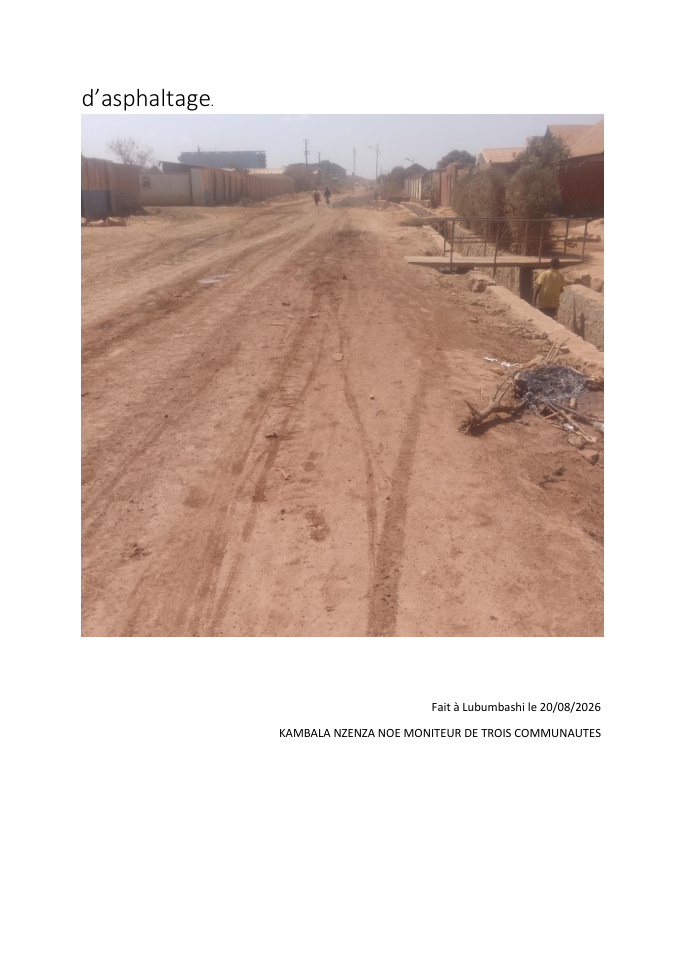
Comme j’avais dans la publication précédente que l’entreprise CDM avais commencé le travaux d’asphaltage de la route qui relie nos trois (3) communautés kassapa, kamatete et kamisepe le travaux de la route évolue car ils ont divise les travaux en deux 2 une équipe travail en commença par le marché Moise jusque devant la prison mais jusque-là ils ont encore au niveau du marché tandis que la deuxième équipe on commence la construction de caniveau en commença juste devant l’entreprise jusque devant la prison mais ils ont a 20 mètre de la prison, là nous sommes dans la même avenue ou il y a même ladite entreprise c’est la route qui doit être asphalte selon le cahier décharge jusque-là nous sommes à ce stade avec l’évolution de travaux d’asphaltage.
Fait à Lubumbashi le 20/08/2026
2 · Ce que cette mise à jour documente
Le document décrit l'avancement des travaux d'asphaltage entre Marché Moïse, la prison et la zone de CDM, ainsi que la construction de caniveaux. Il s'agit d'une mise à jour sur les travaux routiers et de drainage.
03 · CASE TIMELINE
Case timeline
4 Nov 2025
Pollution incident
Retention-basin failure and polluted-water release reported in Kassapa, Kamatete and Kamisepe.
5–7 Nov 2025
Official intervention
Public reporting records official confirmation and suspension of CDM activities.
22 Nov 2025
Judicial investigation
A judicial investigation into the basin failure was publicly reported.
13 Feb 2026
Environmental and remedy follow-up
Public reporting said victim support, environmental measures and an indemnification process were underway.
2 Jul 2026
Road rehabilitation
Public reporting described rehabilitation on the Kasapa / CDM / Marché Moïse road axis.
20 Aug 2026
AMAP field follow-up
New report, photograph and video document continued asphalt and drainage works.
5 Nov 2025 · Actualite.cdRetention-basin rupture and impacts on Kasapa, Kamatete and Kamisepe.Open source ↗
5 Nov 2025 · Radio OkapiFlooding and pollution risks following the CDM basin failure.Open source ↗
7 Nov 2025 · Actualite.cdThree-month suspension of CDM activities.Open source ↗
22 Nov 2025 · Actualite.cdJudicial investigation into the basin failure.Open source ↗
13 Feb 2026 · Actualite.cdOfficial follow-up, victim assistance and environmental measures.Open source ↗
2 Jul 2026 · Kivu Morning PostRoad rehabilitation on the Kasapa/CDM/Marché Moïse axis.Open source ↗
04 · WHAT AMAP FOUND
What this update shows
Road and drainage worksSupported
The supplied report, photograph and video document road and drainage works progressing on 20 August 2026.
Follow-up to the existing caseSupported
The report itself refers back to the earlier CDM road rehabilitation update and the same three communities.
Full environmental clean-upNot yet proven
This new material does not provide complete independent post-incident soil and water results or proof that all remediation obligations are finished.
CASE RECORD
Reports & updates in this case
4 Nov 2025 · IncidentPolluted-water release reported in Kassapa, Kamatete and Kamisepe.Open source ↗
Nov 2025–Feb 2026 · Public follow-upSuspension, investigation, victim support and environmental/remedy measures were publicly reported.Open source ↗
2 Jul 2026 · Road rehabilitationPublic reporting described works on the Kasapa / CDM / Marché Moïse road axis.Open source ↗
20 Aug 2026 · AMAP follow-upNew two-page report, photograph and video document continued asphalt and drainage works.AMAP field evidence
ACCOUNTABILITY TRACKER
Who needs to answer
AMAP tracks whether the relevant company and public authorities have been notified, whether they respond, and what action follows. Contact details used for notification are retained internally and are not published on this page.
Congo Dongfang Mining (CDM)Company linked to the reported pollution incident and to the road area documented in the follow-up.
RESPONSE REQUEST PENDING
Accountability questionClean-up records; post-incident soil and water testing; current monitoring; role in road/drainage works; remedy or compensation status.
Respond on AMAP ↗
DRC environmental authoritiesEnvironmental oversight and monitoring.
RESPONSE REQUEST PENDING
Accountability questionEnvironmental measures ordered or completed; available soil/water tests and monitoring results; current environmental status of affected areas.
Respond on AMAP ↗
DRC mining authoritiesMining-sector regulatory oversight.
RESPONSE REQUEST PENDING
Accountability questionRegulatory action concerning CDM; current compliance status; outstanding requirements linked to the incident and environmental recovery.
Respond on AMAP ↗
Haut-Katanga provincial authoritiesProvincial oversight and local follow-up.
RESPONSE REQUEST PENDING
Accountability questionRoad rehabilitation scope and responsibility; drainage works; environmental monitoring; measures addressing impacts on Kassapa, Kamatete and Kamisepe.
Respond on AMAP ↗
GRI STANDARDS FOR THIS CASE
What the reporting standards mean here
These standards help show what information should be disclosed and followed up.
GRI 303
Water and effluents
The underlying incident concerns polluted water and possible impacts on water sources and groundwater.
FOR THIS CASEShow post-incident water-quality tests, discharge controls and ongoing monitoring.
GRI 306
Waste
The original incident involved a retention system holding industrial/mining effluent; waste and effluent management remain relevant to prevention and remediation.
FOR THIS CASEExplain how waste and effluent are now contained, managed and prevented from recurring.
GRI 413
Local communities
The case concerns impacts on homes, fields, roads, market access, water use and community remedy.
FOR THIS CASEShow community engagement, assistance, complaints handling, compensation and remedy.
GRI 14
Mining sector standard
This connects mining-specific environmental and community impacts with company accountability and disclosure.
FOR THIS CASEShow what CDM did, what regulators required and what obligations remain open.
DRC MONITOR UPDATE · HAUT-KATANGA · 20 AUG 2026
Road and drainage works linking Kassapa, Kamatete and Kamisepe
Two-page field update documenting progress on asphalt and drainage works. This is follow-up evidence within DRC Case 001; it does not establish that environmental clean-up is complete.
Open full original report ↗Evidence in this update2-page report · photograph · video
Main questionRoad rehabilitation is visible; environmental clean-up remains a separate question
What we still need to knowIndependent soil/water tests and complete remediation records
RIGHT OF RESPONSE
Respond to this case
Company representatives, public authorities, affected communities and other stakeholders may respond, correct or update the record on DRC Case 001. Responses submitted below are published directly on this page, unless they break AMAP’s publication rules — insults and abuse, sexual or pornographic material, threats, unproven defamatory allegations, or advertising and spam. Flagged submissions are kept and referred to AMAP for review instead of being published.
CASEDRC Case 001CDM pollution & road rehabilitation follow-up
Publication and privacy: personal email addresses and contact details are never displayed publicly. Publication does not mean that AMAP has verified, adopted or endorsed the response.
PUBLIC RIGHT-OF-RESPONSE RECORD
Responses received
No response published yet
Responses submitted above are published here once they pass AMAP’s publication rules. Published responses represent the respondent’s position and are not automatically verified or endorsed by AMAP.